Showing posts with label Palestine. Show all posts

Wednesday, September 16, 2020

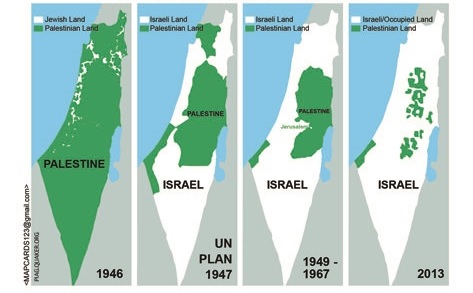
Talk of Annexation--Again

 In the January 1984 issue of Palestine Perspectives, Muhammad Hallaj wrote an editorial entitled "Injustice is Never Irreversible" that addressed the then current topic of annexation or de facto annexation of the Occupied Territories.

Dr. Hallaj raised two questions: 

1. Does military occupation become "irreversible?" In our view it does not. The forceful subjugation of one people by another cannot acquire legitimacy due to the unilateral act of the occupier, although such acts may very well make the withdrawal symptoms more severe.

2. The second question which needs to be raised is this: what happens to the Arab-Israeli conflict if Israel's de facto annexation of the occupied West Bank and Gaza does become "irreversible?"

Hallaj recognized the possibility that, given the vastly unequal balance of power, such possibility exists.

In that case only what Israel wants would be achievable. But in that case it makes no difference what the Palestinians do, because Israel is dead set against Palestinian self-determination—with or without association with Jordan—as its immediate and categorical rejection of the Reagan scheme and as its refusal even to discuss the cessation of settlement demonstrates.

However, it behooves those who advise the Palestinians to swallow whatever it is that is being shoved down their throats, as a presumed alternative to oblivion, to consider another theoretical possibility which is transformable into a practical option...the struggle with Israel would cease to be over the West Bank and would become again a struggle over Palestine. In other words, instead of closing the file on the Palestinian people, Israel's annexation of the West Bank and Gaza would re-open the file from the beginning.

In the nearly 37 years that have elapsed since the writing of the editorial, much has remained the same: the Israelis still talk of annexation, and they are still supported by the powers that be in the United States. Unfortunately, that does not mean we have come full circle, stuck in a repeating cycle. The Palestinian position has weakened in the interim. 

The West Bank struggles with the stranglehold Israel has over the water supply, not to mention the supply lines of everything else that it needs to continue life as usual. Outside help wanes as economies around the world face uncertainty in the face of a continuing pandemic.

The situation in Gaza is desperate. After years of blockade in conjunction with continuous and violent suppression, the people of Gaza struggle to survive. Electricity is intermittent due to the scarcity of fuel for the power plant; medicines of all sort are in sort supply; the water treatment plant languishes in scarce energy and maintenance hampered by lack of parts. The hospitals struggle to meet the day-to-day needs of the community, yet they are called upon to reach even greater demand by recurring violence and now the worldwide struggle with covid-19 adds to the misery.
 

Sunday, March 1, 2020

The Elections are Coming!

It is a sad commentary on the state of the Palestinians and their struggle for freedom that articles written more than thirty-five years ago are just as relevant and applicable to their plight today as they were the day they were written. In the November/December 1983 issue of Palestine Perspectives, Muhammad Hallaj wrote the following commentary:
It is often said that the presidential election season is a time of paralysis for American foreign policy. This may be true in some areas of U.S. foreign policy, but certainly not in the Middle East. American policy toward the Arab-Israeli conflict does not suffer from paralysis, but instead becomes gripped with a fit of epilepsy.
This pathetic seasonal phenomenon has already made its appearance in preparation for the coming elections. The various contestants, whether they are guarding their jobs or grabbing for them, have already begun to pay homage to Greater Israel. Although we have become somewhat accustomed to this irresponsible ritual, occasionally we are still shocked by how far some candidates go in sacrificing America's interests and integrity in their chase after votes and campaign money. 
This piece was written in response to a speech by Senator John Glenn to the Foreign Policy Association in New York. Dr Hallaj summarized the main thrust of the speech as "an attack on the concept of 'evenhandedness' in U.S. Middle East Policy. He [Senator Glenn] charged that evenhandedness means a 'tilt away from Israel,' as if that were a self-evident evil."

Those words were penned as the nation prepared for the 1984 elections. Today we are preparing for the 2020 elections. Decades have passed, yet in the midst of it all, American policy toward the Arab-Israeli conflict suffers another seizure. The new Middle East Peace Plan is introduced by none other than Benjamin Netanyahu, the Prime Minister of Israel. It is a plan tilted so far toward Israel that even The New York Times cannot ignore the tilt.
Mr. Trump vowed at the start of his presidency that he would negotiate a “bigger and better deal” to broker peace than anyone could imagine. Three years later, experts say that the plan, developed under the supervision of Jared Kushner, Mr. Trump’s son-in-law, falls remarkably short of that goal and is unlikely ever to become the basis for a peace agreement. https://www.nytimes.com/2020/01/29/world/middleeast/trump-peace-plan-explained.html 

 What is that saying? The more things change, the more they remain the same.
The phrase was coined by French writer Jean-Baptiste Alphonse Karr, “plus ça change, plus c’est la même chose.

Saturday, February 1, 2020

Peace Process Revisited

Muhammad Hallaj wrote the following in his editorial in the November/December 1983 issue of Palestine Perspectives. Unfortunately, his words are just as true and applicable today, more than 35 years later, as it was when he wrote it.

For the first time in recorded history, the world community committed itself in the twentieth century to the ideal of universalizing self-government and economic well-being. Self-determination an development became primary objectives of contemporary human civilization.
The transformation of Palestine into Israel in 1948 and in subsequent years deprived the Palestinian people of the opportunity to share this human dream. They have been denied self-government, and their lives have been disrupted and harassed. 
Granted, the vision of universalizing self-government and development has been only partially and imperfectly achieved. Hundreds of millions of people around the world continue to suffer from hunger, disease and ignorance. And in many countries decolonization has not brought liberty and justice to their peoples. The struggle has not yet been consummated everywhere. But nowhere in the world, except in Palestine, has the deprivation been so deliberate, conscious and determined. 
In other places, the problem has been a failure of the dream, a failure to benefit from an opportunity which has been granted. In Palestine, it has been a failure to grant the opportunity and to share the dream. And that is the rationale and the nobility of the Palestinian struggle... 
The struggle in Palestine is not about the location of boundaries, the confiscation of land, the dissolution of municipalities or political imprisonment, although it concerns all of this and much more. It is fundamentally about the inadmissibility of singling out the Palestinian people for denial of access to the contemporary dream. 
All efforts and initiatives made in the name of peace in the Middle East which fail to take this fact as their underlying premise are doomed to fail and deserve to fail. They are doomed to fail because they do not address the issue, and they deserve to fail because they make a mockery of a universally cherished human vision.
And so it is that we begin one more decade with one more mockery of justice.

Saturday, January 30, 2016

It's Always Time for HUMMUS


Americans think of hummus as a dip; Arabs think of hummus as a meal—especially at breakfast time. Early in the morning, children scurry down streets in their pajamas, or with a dress or jacket thrown over pajamas. Each child carries a plate and a few coins, and all heading for the nearest hummus maker. Nothing beats good hummus with fresh pita bread for breakfast—unless you add falafel.
Breakfast doesn't last all day, but hummus can. For many families in the Arab world, the main meal of the day is at midday. If someone, or several someones happen to visit at meal time, a quick trip to the local hummus maker can stretch every meal to accommodate everyone.
 Unfortunately, where we live, there is no local hummus maker. So... I make my own. We haven't found a pre-made hummus that suits us, but it isn't hard to make.

  Add a can of chickpeas, tahini (sesame seed paste), lemon juice, and a little garlic in a food processor and let 'er rip. Make sure it is a smooth paste and not grainy. Canned chickpeas work just as well as cooked dried chickpeas, although there are purists who disagree. Don't forget to keep out a few chickpeas to use as garnish.

Finish the garnish with sumac and parsley. Top with extra virgin olive oil, and it's ready to go.

I did say hummus was good anytime, didn't I?

Ever have a day with no inspiration for dinner? Try this: Crumble some ground meat in a skillet, add some pine nuts that have been lightly browned in olive oil. Instead of the sumac and parsley, put the meat on a dish of hummus. Top with browned pine nuts. Serve with a veggie platter—and add some pickled turnips, or dill pickles if you can't find turnips.

If you want to top your hummus with some of the best olive oil in the world, try some made from olives grown in Palestine. I buy mine from Canaan Fair Trade. They sell all kinds of great food. https://www.canaanusa.com/shop?code=USC

This video shows a Palestinian woman making hummus with a blender. While she doesn't use as much tahini as I would use, I love watching the family eat. Notice that they use little snippets of bread and pop the whole thing in their mouths. No double dipping, just sharing.

Friday, June 19, 2015

International Refugee Day - June 20, 2015

Palestinians are the largest and longest suffering group of refugees in the world. One in three refugees world wide is Palestinian. There are about 6.5 million Palestinian refugees worldwide. More than 3.8 million Palestinian refugees and their descendents displaced in 1948 are registered for humanitarian assistance with the United Nations. Another 1.5 million Palestinian refugees and their descendents, also displaced in 1948, are not registered with the UN. About 263,000 Palestinians and their descendents are internally displaced i.e. inside present-day "Israel".

     Descendents of refugees are included in the total population because they are still unable to realize their basic rights. About 20,000 Palestinians were internally displaced in the West Bank and Gaza Strip by 2001, some 3,000 of whom were newly displaced during that year. At least 26,000 Palestinians left the West Bank and Gaza Strip for Jordan and did not return between June 2000 and July 2001. Such transfer of the Palestinian population driven by hard econmic and discriminatory conditions continues today. 
The refugee camps began as tent cities in 1948. The inhabitants expected to be returning home in a matter of days or weeks.
It has now been a matter of generations. In many places they are refused permission to work. In others, access to available work is restricted by checkpoints. 
Political conditions and restrictions as well as  frequent outbreaks of violence conspire to keep the inhabitants from gathering the resources needed to move out of the camps.

(See http://www.unrwa.org for this and other photos of refugee camps and refugee life.)

One such checkpoint is Kalandia (often spelled Qalandia). Checkpoints Project on Youtube has a series of 6 videos focusing on the checkpoints. The first is Kalandia: A Checkpoint Story that shows the evolution of the checkpoint.

My novel, Checkpoint Kalandia, shows the impact such a checkpoint can have on the everyday life of a refugee family.

http://www.unrwa.org/donate


Many of these families still rely on the generosity of others
to survive. In honor of World Refugee Day, please consider making a donation to help them. 


Sunday, February 1, 2015

Super Bowl Sunday


The first thing that penetrated my sleep-fogged mind this morning was the announcer on the television set telling me that a ticket near the 50-yard-line of today's game would cost about $15,000.


FIFTEEN THOUSAND DOLLARS?? 

FOR ONE TICKET--TO ONE GAME??

I was suddenly wide awake and filled with a mix of strong emotions--outrage, sadness, and a feeling of helpless frustration. I was yelling at the television set,

"DO YOU HAVE ANY IDEA HOW MANY PEOPLE THAT COULD FEED? 

HOW MANY BLANKETS FOR FREEZING REFUGEES?"
http://en.tempo.co/read/beritafoto/12250/Syrian-Refugees-in-Lebanon-Face-Bitter-Winter/6
"They can't hear you. You know that, don't you?"
My husband, always the voice of reason. I know he was talking about the television, but it holds true for a much broader audience. They can't hear me--yet. 
One of the reasons I started writing novels is to reach an audience that has little or no knowledge of the plight of refugees, how they live, or what desperate efforts they make just to have a touch of normalcy in their lives.

http://amazon.com/dp/1633200183/
http://www.amazon.com/dp/1633200035/
Refugees are just like us. They have families they care about, have hopes for their children to have a better life. They do what they can to survive and try to boost their children into a better world. Each family has a story; each story has moments of sadness and moments of triumph.


Yes, I understand that nobody ever said life was fair, but understanding and accepting are very different. 


What can you do to make a difference?
http://www.endtheoccupation.org
  • You can stay informed. Listen to what's happening in other parts of the world.
  • Be compassionate. People are people regardless of the flag flying overhead.
  • Remember the less fortunate, and give what you can.
United Nations Relief and Works Agency
http://www.unrwa.org
International Rescue Committee
http://www.rescue.org

Monday, September 8, 2014


International Literacy Day
September 8, 2014


  "Literacy is a key lever of change and a practical tool of empowerment on each of the three main pillars of sustainable development: economic development, social development and environmental protection."
Former UN Secretary-General, Kofi Annan

Today is International Literacy Day, a day to celebrate and encourage literacy. All over the world tremendous strides are being made in literacy and education, but there are many notable exceptions. There are even places, such as Gaza, where literacy is moving the wrong way. Children are being hampered in their learning by external forces.
According to the New York Times, there are 648 schools in Gaza with 421 of the buildings being shared in double shifts. Since the recent violence, 34 buildings have been damaged beyond repair and dozens more need major repairs. Add the addition of 60,000 people whose homes were destroyed that are being sheltered in school buildings, and you have an insurmountable problem. (http://www.nytimes.com/2014/09/06/world/middleeast/broken-buildings-and-bruised-psyches-complicate-start-of-gaza-school-year.html?_r=0)

Schools are already three weeks late, and an opening day is not in sight. Even if schools were to open tomorrow, how many children would be able to study and learn? Democracy Now! Gives August 21 numbers as: 500 kids dead, 3,000 injured (over 1,000 of whom will suffer from lifelong disability), and 373,000 traumatized. Pernille Ironside, chief of UNICEF’s Gaza field office said, “There isn’t a single family in Gaza who hasn’t experienced personally death, injury, the loss of their home, extensive damage, displacement, The psychological toll that has on a people, it just cannot be overestimated, and especially on children."
http://www.democracynow.org/2014/8/21/a_war_on_gazas_future_israeli

Sadly, many of these children may never reach their full potential, yet there are ways we can help.
You can help UNRWA rebuild schools in Gaza
Click here to donate
***DONATE TO THE GAZA EMERGENCY APPEAL TODAY***
UNRWA must repair, rebuild, equip schools and they also provide food and counseling when they can.