Showing posts with label Palestinian. Show all posts

Wednesday, September 16, 2020

Talk of Annexation--Again

 In the January 1984 issue of Palestine Perspectives, Muhammad Hallaj wrote an editorial entitled "Injustice is Never Irreversible" that addressed the then current topic of annexation or de facto annexation of the Occupied Territories.

Dr. Hallaj raised two questions: 

1. Does military occupation become "irreversible?" In our view it does not. The forceful subjugation of one people by another cannot acquire legitimacy due to the unilateral act of the occupier, although such acts may very well make the withdrawal symptoms more severe.

2. The second question which needs to be raised is this: what happens to the Arab-Israeli conflict if Israel's de facto annexation of the occupied West Bank and Gaza does become "irreversible?"

Hallaj recognized the possibility that, given the vastly unequal balance of power, such possibility exists.

In that case only what Israel wants would be achievable. But in that case it makes no difference what the Palestinians do, because Israel is dead set against Palestinian self-determination—with or without association with Jordan—as its immediate and categorical rejection of the Reagan scheme and as its refusal even to discuss the cessation of settlement demonstrates.

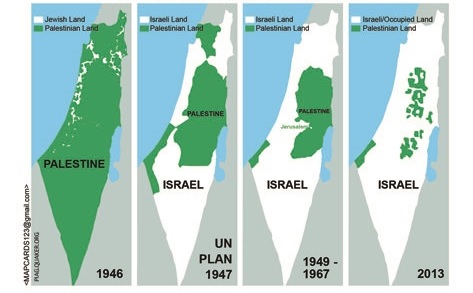
However, it behooves those who advise the Palestinians to swallow whatever it is that is being shoved down their throats, as a presumed alternative to oblivion, to consider another theoretical possibility which is transformable into a practical option...the struggle with Israel would cease to be over the West Bank and would become again a struggle over Palestine. In other words, instead of closing the file on the Palestinian people, Israel's annexation of the West Bank and Gaza would re-open the file from the beginning.

In the nearly 37 years that have elapsed since the writing of the editorial, much has remained the same: the Israelis still talk of annexation, and they are still supported by the powers that be in the United States. Unfortunately, that does not mean we have come full circle, stuck in a repeating cycle. The Palestinian position has weakened in the interim. 

The West Bank struggles with the stranglehold Israel has over the water supply, not to mention the supply lines of everything else that it needs to continue life as usual. Outside help wanes as economies around the world face uncertainty in the face of a continuing pandemic.

The situation in Gaza is desperate. After years of blockade in conjunction with continuous and violent suppression, the people of Gaza struggle to survive. Electricity is intermittent due to the scarcity of fuel for the power plant; medicines of all sort are in sort supply; the water treatment plant languishes in scarce energy and maintenance hampered by lack of parts. The hospitals struggle to meet the day-to-day needs of the community, yet they are called upon to reach even greater demand by recurring violence and now the worldwide struggle with covid-19 adds to the misery.
 

Sunday, March 1, 2020

The Elections are Coming!

It is a sad commentary on the state of the Palestinians and their struggle for freedom that articles written more than thirty-five years ago are just as relevant and applicable to their plight today as they were the day they were written. In the November/December 1983 issue of Palestine Perspectives, Muhammad Hallaj wrote the following commentary:
It is often said that the presidential election season is a time of paralysis for American foreign policy. This may be true in some areas of U.S. foreign policy, but certainly not in the Middle East. American policy toward the Arab-Israeli conflict does not suffer from paralysis, but instead becomes gripped with a fit of epilepsy.
This pathetic seasonal phenomenon has already made its appearance in preparation for the coming elections. The various contestants, whether they are guarding their jobs or grabbing for them, have already begun to pay homage to Greater Israel. Although we have become somewhat accustomed to this irresponsible ritual, occasionally we are still shocked by how far some candidates go in sacrificing America's interests and integrity in their chase after votes and campaign money. 
This piece was written in response to a speech by Senator John Glenn to the Foreign Policy Association in New York. Dr Hallaj summarized the main thrust of the speech as "an attack on the concept of 'evenhandedness' in U.S. Middle East Policy. He [Senator Glenn] charged that evenhandedness means a 'tilt away from Israel,' as if that were a self-evident evil."

Those words were penned as the nation prepared for the 1984 elections. Today we are preparing for the 2020 elections. Decades have passed, yet in the midst of it all, American policy toward the Arab-Israeli conflict suffers another seizure. The new Middle East Peace Plan is introduced by none other than Benjamin Netanyahu, the Prime Minister of Israel. It is a plan tilted so far toward Israel that even The New York Times cannot ignore the tilt.
Mr. Trump vowed at the start of his presidency that he would negotiate a “bigger and better deal” to broker peace than anyone could imagine. Three years later, experts say that the plan, developed under the supervision of Jared Kushner, Mr. Trump’s son-in-law, falls remarkably short of that goal and is unlikely ever to become the basis for a peace agreement. https://www.nytimes.com/2020/01/29/world/middleeast/trump-peace-plan-explained.html 

 What is that saying? The more things change, the more they remain the same.
The phrase was coined by French writer Jean-Baptiste Alphonse Karr, “plus ça change, plus c’est la même chose.

Wednesday, December 23, 2015

Arabic Bread: an important part of culture


© 2010 jeffreyw, Flicker from Wylio.com

Arabic bread is more than just a food. It is an integral part of the culture across the Arab world, and no wonder, since historians believe that wheat and barley were first domesticated in the Fertile Crescent about 10,000 years ago. At that time the first grinding stone was invented in Egypt, and the first grain was crushed. The first bread was flat and thin, similar to tortillas. ("History of bread," Wikipedia, The Free Encyclopedia, https://en.wikipedia.org/w/index.php?title=History_of_bread&oldid=696359727 (accessed December 23, 2015).
     It is widely thought that the Egyptian skill with brewing beer and the warm climate led to the discovery of levening. Around 2500 BC, the first leavened breads were made in Egypt. (Encyclopedia of Food and Culture | 2003 | Franklin, Peter S. COPYRIGHT 2003 The Gale Group Inc. as quoted in http://www.encyclopedia.com/topic/bread.aspx)
     Ever since that time, Bread has been part of each meal. The soft flat loaves can serve as a plate. Its soft, pliable texture make it perfect for dipping in liquid or semi-liquid foods. It can be folded into a scoop to pick up anything solid or semi-solid. Endlessly adaptable, it is the plate, the utensil, or the meal itself. Often called aish, which also means life, it is clear that for Arabs, bread is truly the staff of life. With a ten thousand year history, is it any wonder Arabs say that Bread is Life?
     Food plays a large part in my novels, Born a Refugee and Checkpoint Kalandia, just as in real life.  It truly is part of the culture. (http://sandhpublishing.com/Kalandia.html)
     Pita bread, also known as pocket bread, can be made from any standard bread recipe. When it is time to shape the dough, shape into balls about two inches in diameter. Cover with a clean cloth and let rise. After the dough rises, roll each ball into a disc a little less than a half an inch thick and let it rest for 10 or 15 minutes. Baking will puff the loaves into shapes resembling improperly inflated footballs. After the bread cools, each loaf will flatten out into its characteristic shape and there will be a pocket in the middle.


© 2010 jeffreyw, Flicker from Wylio.com
     Although everyone thinks of pita bread when the topic of Arabic bread arises, that is not the only kind of bread native to Palestine. Taboon (or tabun) bread is named after the domed stone ovens that villagers used to build. The ovens resemble stone igloos. On baking day, a fire is built inside the oven. As the fire subsides into embers, the village women slap the thin rounds of dough onto the oven walls. When the dough begins to fall off the wall, it is done. At least that is what I remember from a conversation with an elderly relative who lived in the small village of Burhahm. Today there are other ways of getting similar results. I have seen people bake the bread on an inverted wok over an open flame. It can also be approximated at home. http://arabianmama.com/2013/03/31/palestinian-taboon-bread/ that suggests preheating a flat baking dish covered with small rocks or pebbles to duplicate the texture of the original.

All recipes for good pita bread. It is easy to make at home. Some people use ovens, others used large flat frying pans. There are many videos available that walk you through the process. Here are a couple of my favorites.


Friday, June 19, 2015

International Refugee Day - June 20, 2015

Palestinians are the largest and longest suffering group of refugees in the world. One in three refugees world wide is Palestinian. There are about 6.5 million Palestinian refugees worldwide. More than 3.8 million Palestinian refugees and their descendents displaced in 1948 are registered for humanitarian assistance with the United Nations. Another 1.5 million Palestinian refugees and their descendents, also displaced in 1948, are not registered with the UN. About 263,000 Palestinians and their descendents are internally displaced i.e. inside present-day "Israel".

     Descendents of refugees are included in the total population because they are still unable to realize their basic rights. About 20,000 Palestinians were internally displaced in the West Bank and Gaza Strip by 2001, some 3,000 of whom were newly displaced during that year. At least 26,000 Palestinians left the West Bank and Gaza Strip for Jordan and did not return between June 2000 and July 2001. Such transfer of the Palestinian population driven by hard econmic and discriminatory conditions continues today. 
The refugee camps began as tent cities in 1948. The inhabitants expected to be returning home in a matter of days or weeks.
It has now been a matter of generations. In many places they are refused permission to work. In others, access to available work is restricted by checkpoints. 
Political conditions and restrictions as well as  frequent outbreaks of violence conspire to keep the inhabitants from gathering the resources needed to move out of the camps.

(See http://www.unrwa.org for this and other photos of refugee camps and refugee life.)

One such checkpoint is Kalandia (often spelled Qalandia). Checkpoints Project on Youtube has a series of 6 videos focusing on the checkpoints. The first is Kalandia: A Checkpoint Story that shows the evolution of the checkpoint.

My novel, Checkpoint Kalandia, shows the impact such a checkpoint can have on the everyday life of a refugee family.

http://www.unrwa.org/donate


Many of these families still rely on the generosity of others
to survive. In honor of World Refugee Day, please consider making a donation to help them.