Showing posts with label Refugee Without Refuge. Show all posts

Thursday, June 20, 2013

WORLD REFUGEE DAY - June 20


June 20th was declared World Refugee Day less than thirteen years ago. Millions of Palestinians have been refugees for five times that many years. Over a million Syrian refugees have joined their ranks only recently, and their numbers are growing daily.

The United Nations reports that more than 45.2 million people have been displaced from their homes due to conflict or violence, making it the highest number since 1994, when millions of people fled ethnic violence in former Yugoslavia and genocide in Rwanda.

And each day, another 23,000 people begin to search for safety from harm or persecution—the world has a new refugee or internally displaced person every 4.1 seconds. “Each time you blink, another person is forced to flee,” said Antonio Guterres, chief of the U.N.’s Refugee Agency, in Geneva. Earlier, he called the numbers “truly alarming.”  http://world.time.com/2013/06/20/the-worst-refugee-crisis-in/

No one wants to be a refugee. They didn't want to flee their homes, often with nothing but the clothes on their backs. They don't want to live on borrowed land, dependent on the charity of the world. No one chooses that path easily. It is chosen as a last resort—an alternative to certain death for loved ones.

Refugees love their families. They have hopes and dreams. Refugees would like nothing better than to leave their refugee status behind and live normal lives with only the ordinary problems of going to work each morning and raising their children to be good decent people...but that is not an option for them.

As UNHCR Special Envoy Angelina Jolie said in her press release today, 20 June 2013
I have met refugees around the world. They are resilient, hardworking and gracious people. They have experienced more violence and faced more fear than we will ever know. They have lost their homes, their belongings and their countries. They have often lost family and friends to horrific deaths. Faced with war and oppression they have chosen not to take up arms, but to try to find safety for their families. They deserve our respect, our acknowledgment and our support – not just today but for the duration of their ordeal. http://www.unhcr.org/51c2f7c26.html


Friday, February 8, 2013

Dispossession and Destruction


What would you do if you woke up one cold winter morning and someone with a gun and a uniform handed you a demolition order for your house?

When a heavily armed group of soldiers are outside your door, there is not much you can do.  This is happening in the Palestinian village of Jaba.  The people of the village live on land that Israel wants for an illegal settlement.  See http://www.presstv.ir/detail/2013/02/04/287269/israel-to-raze-another-palestinian-village/ to see a video that shows the poverty of this village, and interviews with several of the residents.  This is not the first time the army has demolished homes in the village, and I’m sure it won’t be the last.  Soon Jaba will be added to the list of Palestinian villages that have been totally erased from the face of the earth.

Wikipedia has a table showing 531 destroyed/depopulated localities in the period from November 1947 to July 1949 alone.  This was just the beginning.  Towns, villages, hamlets, and neighborhoods are continually eroded and eventually erased by the forces of occupation.

If you search YouTube for Demolished Palestinian Villages, you will find 2,400 results. I have chosen a recent one to embed in this post.
The Palestinians cling to their heritage and beg the world to notice.
Samer Issawi is one of the many, many political prisoners in Israeli jails.  Samer is giving his life to call attention to what is happening in Palestine.  As I write this (February 8, 2013) his has been on a hunger strike for 200 days.  His body is shutting down, his captors mock his efforts, and still the media ignores him. (See the Free Samer Issawi Campaign on Facebook for more on his story.)  Can you even imagine 200 DAYS without food? I can't go 200 MINUTES without a snack or a cup of tea.


Despair, frustration, and anger can combine with devastating consequences—yet the Palestinians remain steadfast. For a more intimate look at how one family of Palestinian refugees cope with this maelstrom of emotions and their consequences, read my novel, REFUGEE WITHOUT REFUGE http://www.amazon.com/dp/1456486055
 
 
.

Monday, May 7, 2012

Palestinian Food Under Occupation

One aspect of the Israeli Occupation that Palestinians feel strongly about is the co-opting of many of their national foods by the Israelis. Every time Palestinians hear falafel described as “Israeli veggie-burgers,” they cringe. 
Every time they hear hummus described as a national dish of Israel, they shudder.  These things are aggravating, but not life threatening, or even life altering.

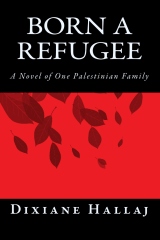
Other aspects of the Israeli Occupation of Palestine, however, have a great impact on the food Palestinians eat, and on their nutrition.  Extended curfews, for example, force people to eat what they have stored in their own homes—no fresh fruits or vegetables.  Since many of the refugee families do not have refrigerators, no meat, poultry, milk, or other food that requires refrigeration.  Canned foods are usually imported and too expensive for most refugee families.  The curfews are a prominent feature of daily life in my novel Born a Refugee.

Poverty in Palestine, like poverty anywhere  in the world, often leads to poor and insufficient diets.  Malnutrition, especially in the area of micro-nutrients is especially rampant among the children of Gaza.  A study by the Palestinian Medical Relief Society found that 52% of the children in Gaza suffer from anemia and severe deficiency in many vital nutrients.  http://www.imemc.org/article/59031

Checkpoints and road closures make travel within Palestine difficult.  People and vehicles face long delays moving from town to town as Israeli soldiers search them.  This aspect of the occupation plays a critical role in my novel, Refugee Without Refuge.

Now there is an additional impediment to the transportation of food supplies within the country—The Apartheid Wall.  The Wall winds its way through over 750 kilometers of Palestine at a cost of approximately $2 million per kilometer.  The Wall separates friends; it separates families; it separates farmers from their land.

It also separates the land that produces one of the signature dishes of Palestinian cuisine from the Palestinian consumers. 
Mloukhieh (or molokhia or molokheya) is considered an acquired taste by some, but Palestinians often refer to it as their national dish.  Mloukhieh is typically cooked in chicken broth and served with chicken.  In my house, the chicken is removed from the broth and browned in the oven, but that is a personal preference.  We also mince the mloukhieh, while the dish in the video below uses whole leaves.  This is a regional difference.  The blog posted the video below and includes recipes as well.  http://vegetarianterroristcookingjournal.wordpress.com/2012/05/02/soup-over-bethlehem-how-apartheid-wall-affects-palestines-famed-mloukhieh/ 
Another blogger uses a different spelling in her blog Food, Nostalgia, and Adventure and gives a good recipe.  She says Palestinians use the whole leaf rather than minced.  Regions differ--even within Palestine. 
Minced or whole leaf, fresh or dried, the Wall makes it is more difficult for the Palestinians to enjoy one of the few pleasures left to them.

Friday, March 30, 2012

Land Day 2012

How many more must lose their lives, suffer severe injuries or unjust imprisonment, or lead lives of violence and despair before the world comes to the realization that in trying to find justice for the Jews of Europe, they created a much larger injustice for the Palestinians?


Damascus Gate Jerusalem


* In Jerusalem at least 2 injured, 5 detained at gates to the old city.  (The numbers are surely higher by the time your read this.) 
Israeli mounted police - Jerusalem
http://blogs.aljazeera.net/liveblog/Land-Day


Kalandia (or Qalandia or Qalandiya) Refugee Camp tweeted by @RichardDufek


* At least 80 wounded in Kalandia and clashes are ongoing. (Before I posted this, the number rose to over 121. May be even higher before the end of the day).


* In Lebanon – In spite of the organizers’ plans to stage their demonstrations at a site several kilometers from the border (see last week’s blog), many angry and frustrated young men cross the barbed wire to wave their flags on Palestinian soil.


 * Gaza – One dead, over 100 seriously injured, including a journalist at checkpoint between Gaza and Israel.


* Confrontations in Bethlehem.
* Syria – Land Day demonstrations scaled back due to ongoing violence.  Five killed today.
* Jordan – More than 15,000 people held a peaceful sit-in near the border with Israel.
As I follow events through live blogs my eyes cloud with tears of frustration and sorrow.
http://blogs.aljazeera.net/liveblog/Land-Day

http://www.guardian.co.uk/world/middle-east-live/2012/mar/30/syria-israel-land-day-palestinian-territories?newsfeed=true

The number of casualties continues to rise as I watch and read. 

In my novel, Refugee Without Refuge, Kareema’s life was changed forever by the demonstration held in the Kalandia Refugee Camp on Land Day, March 30.  Today the story plays out in real life, as it has every year—in Kalandia, in Gaza, in places throughout the Arab World as Palestinians try to draw attention to the continuing encroachment of Israel on private Palestinian land within Israel as well as in the Occupied Territories.
In my novel young Imahn was shot by a rooftop sniper using what is euphemistically called a rubber bullet, causing permanent damage.  Today The Guardian reports: 
12:57pm: Some updates from Phoebe Greenwood at Qalandiya:  “A young protester looks pretty seriously injured, having been shot in the lower back with a rubber bullet which seems to have been fired be [sic] Israeli soldiers in sniper position on a rooftop. He has been bundled into a Red Crescent ambulance.”  http://www.guardian.co.uk/world/middle-east-live/2012/mar/30/syria-israel-land-day-palestinian-territories?newsfeed=true
Am I surprised that the events that happened in my novel are actually happening on the ground?  No more than you would be if you wrote about the tragedy of a tornado hitting a small town, and later read about a remarkably similar incident.  The difference is that this tragedy is caused by acts of men, not forces of nature.  Men who seem to have learned very little through the centuries of civilization.  Tomorrow thousands will mourn the fallen, and for years to come mothers will grieve for their lost sons and daughters, and many more tears will be shed over maimed and broken survivors.
Reading the posts of the reporters for The Guardian as they come over the internet minute by minute describing what is happening, my heart aches for their pain.  Sometime I think I should be there doing my part, but the rest of me realizes that the best I can do now is use my words to continue the fight. 
Al Jazeera has a photo gallery of pictures http://aljazeera.smartgalleries.net/gallery/1333113567642?image_id=00Gfaay3WLc1u including a woman trying to protect her cart of bananas from mounted soldiers.

This 33 second video in Kalandia shows water cannon, tear gas, and sound grenades being used against protesters and efforts by Red Crescent ambulances to reach the wounded

Art and life run parallel as the Land Day Demonstrations in Kalandia today reflect those described in Refugee Without Refuge.


Click HERE to buy


To see more about Dixiane Hallaj and her books:
http://www.hallajs.com

Saturday, March 10, 2012

I thought it was a great near-spring day...

The sun was shining, the daffodils were beginning to bloom, and my local bookstore sent me an email saying that they had sold out all their copies of my novel, Born a Refugee.  What more could a writer want?

And then I looked at the internet to see what was happening.  I didn’t find anything in the major news sources, but following a link from Twitter I found that this was one of the most violent days in Gaza in nearly a year.  Israeli aircraft killed 14 militants—some of them too torn up to be wrapped in cloth, as Muslim tradition dictates.   This picture was taken from the Connecticut Post website ctpost.com. 

The Gaza Strip is only 139 square miles.  This is roughly twice the area of Washington, DC (and much smaller than the DC metro area) and just over one third the area of New York City (again, only the city--not the NYC metropolitan area).  Within this very small area lives a population of 1.7 million people according to an official report by the interior ministry in Gaza Strip, making it one of the most densely populated places in the world. 

Over half a million of those people live in the 8 overcrowded refugee camps overseen by the United Nations Relief and Works Agency.  The over-all unemployment rate is estimated at 40%.  We talk a lot about unemployment in this country and how to lower the unemployment rate.  New business is always cited as one way to increase employment and areas of high unemployment try to attract new businesses.  How do you attract new business to an area where there is constant violence and air strikes can happen any time?  How do you build a place to employ people when the blockade does not allow the import of construction materials--not even materials to rebuild damage caused by the air strikes?  All Gaza has is an abundance of labor.

The on-going blockade only makes the news when attempts to get supplies into Gaza from the outside world results in violence.  The relentless poverty and deprivation that result from the blockade never make the news.

As I was writing this blog post, I received another tweet—three more killed and a further 26 injured, five of whom are in serious condition.

My books, Born a Refugee and Refugee Without Refuge, tell the story of one fictional family living with the constant poverty, overcrowding, violence, and oppression in the Kalandia Refugee Camp on the West Bank.  The conditions I write about do not begin to describe the conditions in Gaza. 


Although the spring season seems to have arrived in my backyard, and the Arab Spring has given hope to millions throughout the Arab World, the people of Gaza have not yet been touched by the warmth of hope. 

Saturday, March 3, 2012

Censorship rears its ugly head on the internet

PayPal has notified a number of online booksellers that it will no longer do business with them unless they remove certain kinds of material from their sites.   Given that PayPal seems to have a virtual monopoly in processing online transactions for many individuals and businesses, this will have a dramatic effect on online sales of many other things.  One of the ebook distributors given this ultimatum by PayPal is Smashwords that distributes Born a Refugee and Refugee Without Refuge in formats for ereaders other than Kindle.  I receive my royalties through PayPal, and I use PayPal to buy books and other things online, including concert tickets for local events.

Paypal is insisting that material including descriptions of rape, incest (and “pseudo-incest,” whatever that is) and bestiality be removed.  I’m a prude.  I admit it.  Although my novels use the words “desire” and “rape,” I never describe either.  I prefer the reader’s imagination to fill in as many or as few details as suits the individual taste.  The fact that I don’t read or recommend erotica does not mean I think their work should be censored.  Censorship of any kind is unconscionable and abhorrent.

Would Sophocles’ Oedipus be denied because it contains incest?  Wasn’t rape central to Steinbeck’s Of Mice and Men?  Is our society regressing to the point of book burning?  What is happening to our individual freedom that we tout so highly as we condemn countries that deny such freedoms?  Yet this censorship is being ignored by the mainstream media.

 “I disapprove of what you say, but I will defend to the death your right to say it,” a saying often attributed to Voltaire, but first said by Evelyn Beatrice Hall when describing Voltaire’s beliefs, also describes my beliefs about what is happening today.  No, I probably would not really defend it to the death, but I think the word should be spread and that every thinking person should lend support to the right to sell legal material using common methods of monetary transactions.  Every book distributor I have dealt with explicitly asks if the books contain adult content, and such books are clearly labeled.  They are not illegal.

Do not think that this is a fight to keep erotica in print—censorship, once started, is far more insidious.   

This act of censorship does not affect my books—yet.  However, I firmly believe that censorship is a slippery slope.  If this can go unchecked, what might be next?  Censorship of books that do not agree with politicians’ views?   Might my own books be banned in the future because they paint a sympathetic portrait of people who disagree with United States foreign policy?  The idea is not as far-fetched as you might imagine. 

The NCAC (National Coalition Against Censorship) website (http://www.ncac.org/) has a section on News.  There are many articles about instances of censorship, including one headlined “MECA Outmaneuvers MOCHA, Shows Palestinian Youth Art Across From Original Gallery” describing the September 2011 instance where the Museum of Children’s Art (MOCHA) cancelled an exhibit of Palestinian children’s art entitled “A Child’s View From Gaza.”  The article tells how the Middle East Children’s Alliance managed to find another venue and attract an audience of thousands to view the exhibit.  http://www.ncac.org/MECA-Outmaneuvers-MOCHA  If an institution like MOCHA yields to pressure and cancels Palestinian children’s art, how different is that from removing books from library shelves, or asking book distributors to remove them from their websites?

The ABFFE (American Booksellers Foundation for Free Expression) website, http://www.abffe.org/, has some eye-opening articles about children’s books that have been banned in Tucson as part of the state’s ban on Mexican American Studies.  The ABFFE home page has a link to a change.org petition to return the books to the students.  It also gives more information about the PayPal Ban.

A letter sent jointly by NCAC and ABFFE that was sent to eBay Inc. and PayPal USA at http://www.scribd.com/doc/83549049/NCAC-ABFFE-Letter-To-PayPal-eBay-re-Ebook-Refusal-2012 shows the email addresses of those who should hear the voices of people crying out against censorship.

Make your voice heard.


Sunday, January 29, 2012

More about familiar books in unfamiliar places

     Writing a book is like starting a snowball rolling down a hill—you never know exactly where it’s going or who it might bump into along the way.  I am astounded at the places my books have surfaced.  Last week I talked about my first book showing up on a medical books site.  This week I found my second novel, Refugee Without Refuge, on a website about weight loss.  Amazing—check out http://letslim.info/products/Refugee.html#  and see for yourself.

     I racked my brains for a while trying to figure out why this might have happened.  I didn’t come up with any answers, but I decided not to worry about it.  The important thing is that I now have more exposure AND the customer rating was FIVE STARS!  What could be better?  The way I see it, this gives me a lot more exposure.  Having another website where people can run into my book is a big deal, and this one has a potentially large readership (no pun intended, really).  If everyone who wants to lose weight sees my book I could have an audience of millions.  It is entirely possible that the number of people who are trying to lose weight outnumber the people who browse through Amazon books!  It is a little hard to pin down numbers, but some studies estimate that as high as 86% of Americans could be overweight—I just hope they browse the web and find my book.

     Writing a book is a tremendously satisfying accomplishment.  It is especially satisfying if the book also tells the reader something important.  I wrote my books about refugees to help people understand that Palestinian refugees are very much like the rest of us.  They have hopes and dreams, they want better things for their children, and they love their families. 

     It gives me great pleasure to know that my books are getting wider and wider distribution on the internet.  Readers have given the books excellent reviews, calling them haunting, compelling, fast-moving, interesting, and a must-read.  I hope that wider web coverage means wider readership and just maybe a wider understanding of some of human issues involve in the Palestine problem.
     You can find links to my books on my website: http://www.hallajs.com